
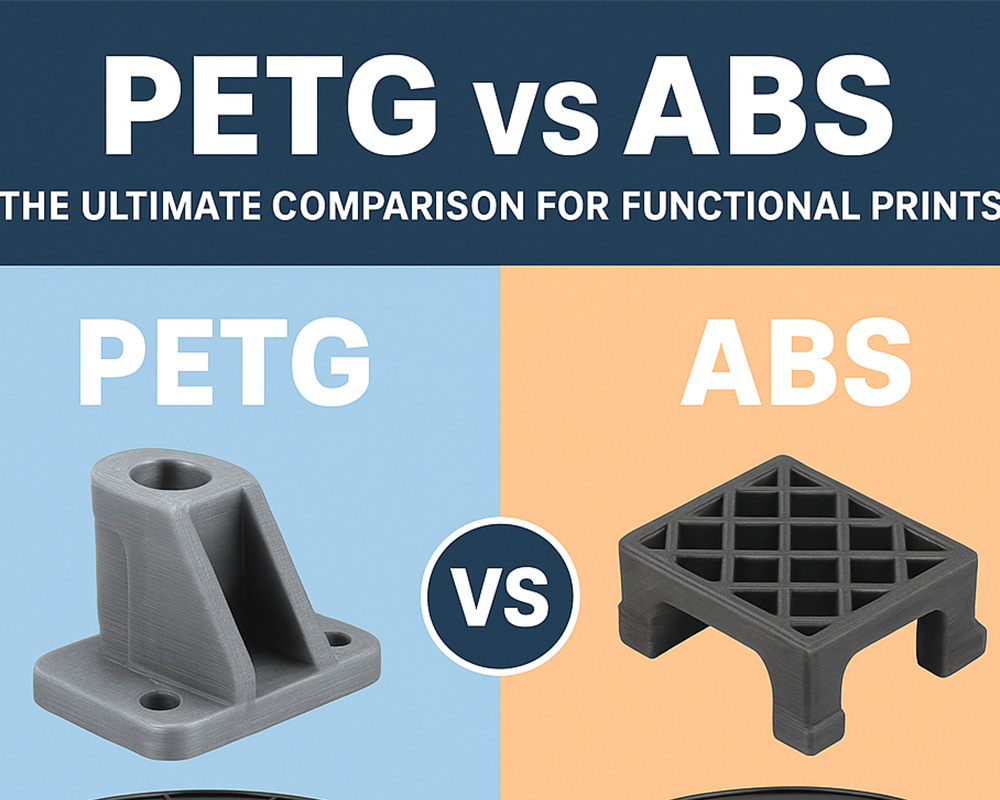
When choosing a filament for functional, load-bearing, or mechanically demanding 3D-printed parts, two materials usually dominate the conversation: PETG and ABS. They are among the most widely used engineering-grade filaments in FDM 3D printing, each delivering a combination of strength, durability, temperature resistance, and reliability that more common consumer materials—like PLA—simply can’t match.
Yet despite their popularity, the debate around PETG vs. ABS remains intense. Makers often want a definitive answer: Which material should I use? Which is stronger? Which lasts longer? Which performs best under stress?
The truth is more nuanced. Both filaments excel in different scenarios, and the right choice depends entirely on the specific requirements of the functional print.
This comprehensive comparison breaks down the mechanical characteristics, printability, long-term performance, environmental resilience, application scenarios, and practical considerations for each material. Whether you’re printing fixtures, enclosures, prototypes, mechanical components, or custom parts for engineering projects, this guide will help you make an informed decision.
Table of Contents
- What Are PETG and ABS?
- PETG vs. ABS: Mechanical Properties
- Ease of Printing PETG vs. ABS
- UV, Chemicals, and Moisture
- Durability and Long-Term Performance
- Post-Processing and Finish Quality
- When to Choose PETG vs ABS
- Cost and Availability
- Safety Considerations
- PETG vs ABS for Functional Prints
- FAQs: PETG vs. ABS for Functional Prints
- Conclusion
1. Understanding the Filaments: What Are PETG and ABS?
What is PETG?
PETG (Polyethylene Terephthalate Glycol-Modified) is a modified version of PET—the same plastic used in water bottles—with glycol added during processing to increase durability and reduce brittleness. This modification enhances its impact resistance, optical clarity, and overall toughness. PETG has become a top choice for functional 3D prints because it blends the best attributes of PLA and ABS:
- Easier to print than ABS
- Better impact resistance than PLA
- Higher temperature tolerance than PLA
- Great layer adhesion
- Low warping
Its mechanical properties also make it suitable for engineering-grade applications where durability and consistency are essential.
To explore it further, see: What Is 3D Printer Filament PETG?
What is ABS?
ABS (Acrylonitrile Butadiene Styrene) is a traditional engineering plastic widely used in industrial manufacturing—think LEGO bricks, automotive parts, and appliance housings. It remains popular in 3D printing because of its:
- High temperature resistance
- Excellent impact durability
- Strong mechanical performance
- Good machinability (sanding, drilling, tapping, gluing)
ABS is often favored for functional prints that must withstand heat or repeated mechanical stress, though it does require higher print temperatures and controlled environments due to warping tendencies.
To explore it further, see: What Is 3D Printer Filament ABS?
2. PETG vs. ABS: Mechanical Properties
Mechanical performance is the defining factor for functional prints. Both PETG and ABS offer engineering-grade characteristics, but in different ways.
2.1 Strength and Tensile Performance
PETG Strength
PETG is known for its high tensile strength and impressive layer adhesion. Because of its slight flexibility and ductility, PETG tends to absorb energy rather than crack. This makes it a good choice for:
- Functional parts exposed to bending forces
- Snap-fits that should not easily break
- Structural brackets
- Enclosures requiring impact resistance
Its layer adhesion is among the strongest of common FDM filaments, which helps prevent delamination in printed components.
ABS Strength
ABS offers excellent strength but leans toward rigidity compared to PETG. While ABS is tough, it can be more prone to cracking under certain sudden impacts—especially if the print’s infill or wall structure isn’t optimized.
However, ABS often performs better under compressive loads and is highly stable dimensionally, which is crucial for mechanical fits and industrial-grade functional prints.
2.2 Ductility and Flexibility
PETG’s Flexibility
One of the reasons PETG has grown in popularity is that it strikes a balance between stiffness and flexibility. It is not rubbery, but it does bend slightly before breaking. This property is useful for:
- Clips
- Hinges
- Lever-based parts
- Shock-absorbing components
ABS’s Flexibility
ABS is less flexible but more robust under mechanical loads. It is rigid, but this rigidity allows it to hold shape and resist deformation under pressure—making it ideal for:
- Structural prototypes
- Gears and mechanical components
- Cases and housings that must not flex
2.3 Impact Resistance
Both materials have high impact resistance, but PETG often outperforms ABS for thin-walled prints, thanks to its ductility. ABS, however, may surpass PETG for thicker components due to its solid mechanical structure.
- PETG: better for distributed impact
- ABS: better for concentrated mechanical loads
2.4 Temperature Resistance
This is one of the most defining differences between PETG and ABS.
- PETG Heat Deflection Temperature: around 70–80°C
- ABS Heat Deflection Temperature: around 95–105°C
This means ABS is more heat-resistant. PETG may soften in hot environments such as inside a car in summer, whereas ABS typically withstands these temperatures.
If your functional print must handle heat—such as automotive components, enclosures near electronics, or mechanical parts exposed to friction—ABS is generally a better match.
3. Printability: Ease of Printing PETG vs. ABS
Even the best material is useless if it’s difficult to print reliably. PETG and ABS differ significantly in their printing requirements.
3.1 PETG Printing Behavior
Ease of Use
PETG is considered user-friendly and sits between PLA and ABS in difficulty. Most modern 3D printers can handle it easily with:
- A heated bed (70–90°C)
- Standard hotend temps (230–250°C)
- No enclosure required
Advantages in Printability
- Minimal warping
- Strong layer adhesion
- Good bridging and overhang performance
- Very low shrinkage
Challenges
- Can string more than ABS
- Can bond too tightly to bare glass (risk of chipping)
- Layers can become too fused, reducing machinability
3.2 ABS Printing Behavior
ABS is known to be one of the more demanding filaments on consumer-level printers.
Requirements
ABS typically requires:
- Hotend temperatures above 240°C
- Heated bed above 100°C
- Enclosure to prevent warping
- Controlled ambient temperature
Challenges
- Warping is common
- Delamination occurs without proper temperature control
- Fumes require ventilation
- ABS parts can crack if cooling is uneven
Despite these challenges, ABS rewards experienced users with rugged, industrial-grade prints.
4. Environmental Resistance: UV, Chemicals, and Moisture
Environmental performance is critical for functional prints that must survive outdoors or in challenging environments.
4.1 PETG Environmental Resistance
UV Resistance
PETG performs well in outdoor settings and maintains color and integrity better than ABS.
Chemical Resistance
PETG is resistant to:
- Acids
- Bases
- Alcohols
- Many solvents
This makes it a solid choice for laboratory parts, fluid containers, and chemically exposed components.
Moisture Resistance
PETG absorbs relatively little moisture compared to PLA or nylon, making it suitable for water-related applications.
4.2 ABS Environmental Resistance
UV Resistance
ABS performs poorly under UV exposure unless UV-stabilized. It may discolor, crack, or embrittle after long-term sun exposure.
Chemical Resistance
ABS offers good resistance to many chemicals but is vulnerable to certain solvents—most famously acetone, which dissolves and smooths ABS prints. This provides an advantage for:
- Chemical welding
- Surface finishing and smoothing
- Post-processing for cosmetic or functional quality
Moisture Resistance
ABS absorbs slightly more moisture than PETG but not enough to significantly impact its stability.
5. Durability and Long-Term Performance
Durability is a combination of mechanical resilience, environmental stability, and resistance to fatigue.
PETG Durability
PETG prints tend to last extremely long due to their ductility and chemical stability. They resist cracking over time and handle repeated stress well. PETG also maintains its physical characteristics in humid or chemically exposed environments.
However, PETG’s lower heat tolerance can be a limiting factor for certain applications.
ABS Durability
ABS excels in long-term mechanical performance, especially in environments with heat and mechanical stress. It resists fatigue, maintains dimensional accuracy, and withstands repeated impacts and loads.
Its only major weakness is UV exposure unless treated or used indoors.
6. Post-Processing and Finish Quality
Post-processing can determine whether your functional print is ready for professional use.
6.1 PETG Post-Processing Capabilities
- Sanding PETG is possible but more challenging due to its ductile nature.
- PETG tends to “gum up” sandpaper.
- Painting PETG requires proper surface preparation.
- Gluing PETG can be harder because common adhesives do not bond strongly.
PETG produces visually attractive prints with glossy surfaces and excellent layer adhesion, but finishing them is more difficult.
6.2 ABS Post-Processing Capabilities
ABS is much easier to post-process:
- Sands smoothly
- Drills and taps without microcracking
- Bonds with solvents or ABS glue
- Responds to acetone vapor smoothing for a professional finish
This is one of ABS’s biggest advantages for product-ready parts.
7. Typical Applications: When to Choose PETG vs ABS
Best Uses for PETG
PETG is ideal for:
- Functional prototypes
- Outdoor components
- Mechanical parts requiring flexibility
- Fluid handling parts
- Impact-resistant housings
- Chemical-exposure environments
- Kitchen or household items
PETG is the go-to for users who want strong, durable, easy-to-print components without dealing with ABS warping or fumes.
Best Uses for ABS
ABS is ideal for:
- High-temperature mechanical parts
- Automotive interior components
- Engineering prototypes
- Gears, pulleys, and machine parts
- Enclosures for electronics
- Structural components requiring rigidity
- Parts requiring detailed post-processing
If you need industrial-grade performance and durability, ABS often delivers superior results—provided you have the proper printing setup.
8. Cost and Availability
Both PETG and ABS are widely available and competitively priced.
- PETG tends to be slightly more expensive than ABS
- ABS is widely produced and often cheaper
However, specialty blends (carbon fiber, glass fiber, UV-resistant grades) can vary in price.
9. Safety Considerations
PETG Safety
PETG emits minimal odors and is considered safer for home environments.
ABS Safety
ABS releases fumes that can irritate the respiratory system, making:
- Ventilation
- Filtered enclosures
- Proper handling
important for safe operation.
10. Final Verdict: PETG vs ABS for Functional Prints
Choosing between PETG and ABS depends on your specific needs.
Choose PETG if you want:
- Strong, tough, impact-resistant parts
- Minimal warping and easy printability
- Excellent chemical and moisture resistance
- Good outdoor durability
- A safer printing environment
PETG is best for users who want reliability and versatility without advanced printing requirements.
Choose ABS if you want:
- Higher heat resistance
- Industrial-grade mechanical strength
- Excellent dimensional stability
- Extensive post-processing options
- Parts used in automotive or mechanical assemblies
ABS is best for experienced users or professionals who need high-performance parts and have the equipment to manage controlled print environments.
11. FAQs: PETG vs. ABS for Functional Prints
1. Is PETG stronger than ABS?
PETG offers better impact resistance and layer adhesion, while ABS provides higher temperature resistance and rigidity. Strength depends on the application.
2. Is PETG easier to print than ABS?
Yes. PETG is significantly easier to print and requires no enclosure, while ABS warps easily without controlled temperatures.
3. Which material is better for outdoor use?
PETG performs better outdoors thanks to its UV and moisture resistance. ABS may degrade under prolonged sunlight.
4. Can PETG replace ABS?
In many cases, yes. PETG’s strength, ductility, and ease of printing make it a strong alternative for general functional prints. However, ABS remains superior for high-temperature or heavily load-bearing parts.
5. Which is more heat-resistant?
ABS. PETG begins softening around 70–80°C, while ABS maintains stability above 100°C.
6. Which material is more flexible?
PETG has more flexibility and ductility. ABS is comparatively rigid.
7. Which filament is better for mechanical parts?
ABS is generally better for parts subjected to continuous mechanical stress or high temperatures. PETG is better for impact or chemical resistance.
8. Does PETG produce fumes?
PETG produces minimal odor and is safer for home environments compared to ABS, which emits noticeable fumes.
9. Which material looks better visually?
PETG prints often have a glossy, high-quality finish straight off the printer, while ABS benefits more from post-processing like sanding and smoothing.
10. Is ABS still worth using in 2026?
Absolutely. Despite newer materials entering the market, ABS remains a reliable, cost-effective engineering filament for serious functional prints.
Conclusion
The debate between PETG vs. ABS is not about which filament is universally “better,” but rather which is best suited for your specific functional print requirements. PETG excels in ease of use, impact resistance, chemical durability, and outdoor performance. ABS shines in high-temperature environments, mechanical stability, and post-processing flexibility.
Understanding the strengths and limitations of each material ensures you can choose the right filament for every functional project—whether you’re printing durable brackets, engineering prototypes, automotive components, or long-lasting mechanical parts.