
What Is 3D Printer Filament TPE? A Complete Guide to Thermoplastic Elastomers in Additive Manufacturing

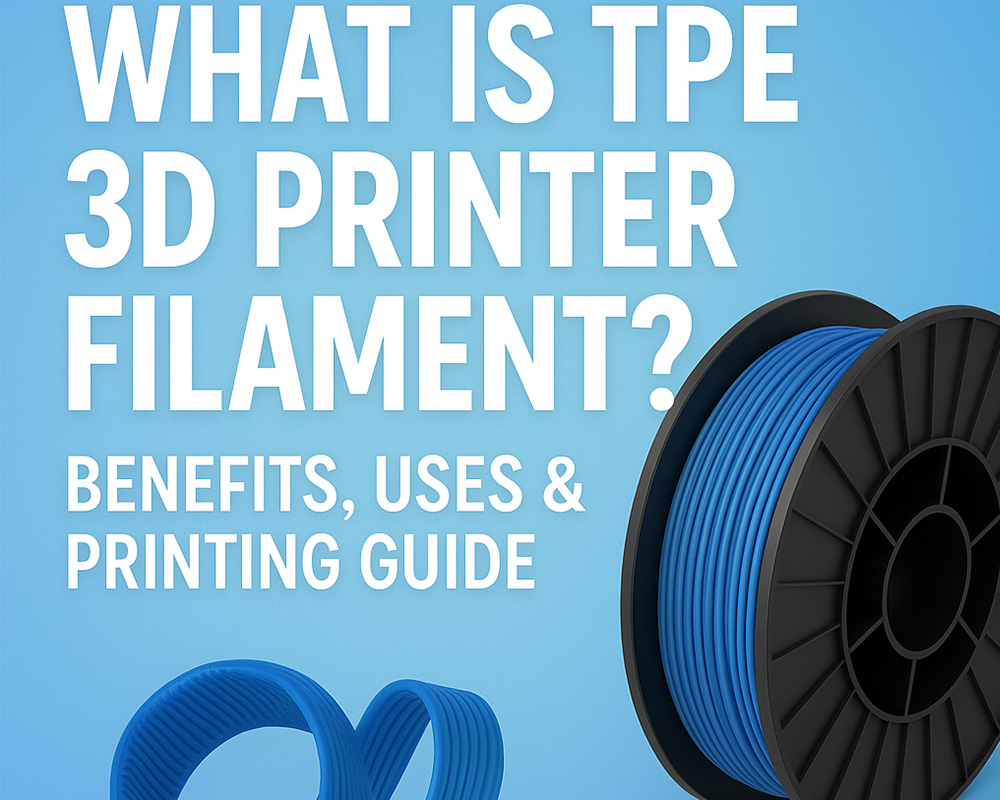
In the ever-expanding world of additive manufacturing, few materials have brought as much versatility and excitement to creators as flexible filaments. Among them, TPE filament—short for Thermoplastic Elastomer filament—stands out as a dominant force. It combines the characteristics of traditional rubber with the convenience and flexibility of thermoplastics. Whether you are a product designer, engineer, hobbyist, or advanced prototyping professional, understanding what makes 3D printer filament TPE so widely used can help you get better results.
This comprehensive guide dives deep into what TPE is, how it performs in 3D printing, why it’s used across so many industries, and how you can unlock its full potential. If you’re looking for a complete, professional-grade explainer, you’ve found it.
Table of Contents
- What Is TPE?
- TPE Filament in 3D Printing
- Key Properties of TPE Filament
- TPE vs. TPU: What’s the Difference?
- Advantages of TPE for Additive Manufacturing
- Common Applications of TPE Filament
- Print Settings and Best Practices
- Challenges When Printing With TPE
- How to Store TPE Filament
- Environmental and Safety Considerations
- TPE in Industrial Manufacturing vs. 3D Printing
- Future Trends in Flexible Filaments
- FAQs
1. What Is TPE?
Thermoplastic Elastomers (TPEs) are a family of polymers that behave like rubber while processing like plastics. In other words, they can stretch, compress, flex, and absorb impact like elastomeric materials, but they can also be melted and reshaped repeatedly like thermoplastics.
Why is this important?
TPE combines two highly desirable characteristics:
- Elasticity similar to silicone or rubber
- Recyclability and reprocessability typical of thermoplastics
This hybrid performance makes TPE particularly valuable for consumer goods, medical devices, wearables, sports equipment, automotive components, and now—additive manufacturing.
2. What Is TPE Filament in 3D Printing?
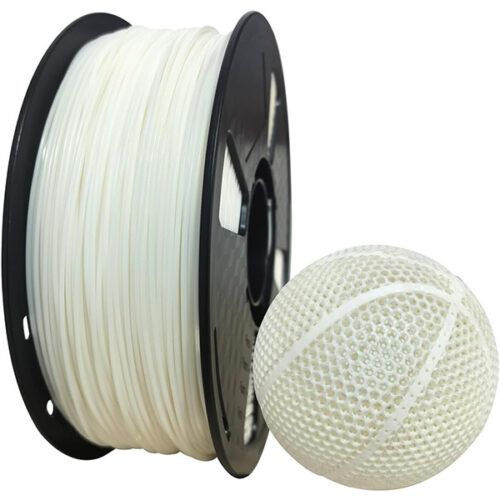
In 3D printing, TPE filament is a flexible filament designed for FDM/FFF printers. It produces parts that are soft, rubber-like, and resilient.
TPE filament is widely recognized for:
- High elasticity
- Excellent impact resistance
- Ability to stretch significantly without breaking
- A soft touch feel
- Durability under repeated movement
It is among the top choices for printing anything requiring flexibility, comfort, or shock absorption.
Typical Shore Hardness
TPE filaments usually fall between Shore A 70–90—ranging from soft and stretchy to firm yet flexible. This variation allows makers to select the right grade for their intended purpose.
3. Key Properties of TPE Filament
TPE owes much of its popularity to its high-performance characteristics. Below are some of the material properties that make it ideal for demanding applications.
Elasticity and Flexibility
TPE can bend, compress, and return to its original shape. Its elongation at break is usually high, making it ideal for components that require repeated movement or stretching.
Impact and Shock Resistance
The filament absorbs shocks and vibrations effectively, making it a preferred option in protective components.
Durable and Wear-Resistant
Its resistance to abrasion and tearing makes TPE suitable for outdoor equipment, tools, and wearable products.
Chemical Resistance
TPE shows resistance to:
- Oils
- Greases
- Some solvents
- UV exposure (depending on formulation)
This enhances the life of parts used in real-world environments.
Soft Touch Feel
Many TPE products provide a comfortable, rubbery feel—ideal for grips, handles, straps, and ergonomic products.
Recyclability
Since TPE is thermoplastic, it can be re-melted and reused.
4. TPE vs. TPU: What’s the Difference?
TPE and TPU are often confused because both are flexible filaments. But their characteristics differ.
Property | TPE | TPU |
| Flexibility | Softer, more rubbery | Slightly harder, more rigid |
| Printability | More difficult | Easier, more stable |
| Elasticity | Extremely flexible | Moderately flexible |
| Abrasion resistance | Good | Excellent |
| Shore hardness | Lower (softer) | Higher (firmer) |
| Best Use Cases | Soft parts, wearable items | Tough flexible parts, cases, seals |
Which should you choose?
- Choose TPE for soft, comfortable, rubber-like components.
- Choose TPU for higher strength and easier printing.
5. Advantages of TPE for Additive Manufacturing
1. Exceptional Flexibility
Few 3D printing materials achieve the natural softness and stretch TPE offers.
2. Rubber-Like Performance
It provides elasticity similar to silicone rubber but with the benefits of thermoplastic processing.
3. High Fatigue Resistance
TPE withstands repeated bending cycles without permanent deformation.
4. Excellent Impact Absorption
Its shock-absorbing properties make it ideal for protective components.
5. Wide Range of Applications
From consumer goods to industrial parts, TPE is highly adaptable.
6. Good Print Bed Adhesion
TPE typically adheres very well to build surfaces, reducing warping.
6. Common Applications of TPE Filament
Because of its performance, TPE filament is used across many industries.
Consumer Products
- Watch straps
- Phone grips
- Protective bumpers
- Custom grips for tools
- Soft toys
- Footwear components
Automotive
- Gaskets
- Seals
- Flexible clips
- Noise and vibration dampeners
Medical Devices
- (Non-clinical prototypes)
- Biomechanical parts
- Grips and ergonomic components
Industrial Prototyping
- Flexible couplings
- Handles
- Connectors
- Soft-touch housings
Sports and Wearables
- Protective gear
- Exercise equipment grips
- Custom-fit wearable prototypes
Robotics
- Flexible joints
- Soft actuators
- Robotic grippers
TPE’s adaptability ensures it has a place wherever flexibility is required.
7. Print Settings and Best Practices for TPE
Printing TPE successfully requires a different approach than printing rigid materials.
Recommended Settings
(These vary depending on material brand and grade.)
Extruder Temperature
- 210°C – 240°C
Bed Temperature
- 20°C – 60°C depending on printer and adhesion needs.
Print Speed
- Slow: usually 15–30 mm/s
This helps prevent buckling and ensures consistent flow.
Retraction
- Minimal or off
Retraction can cause filament jams due to TPE’s softness.
Cooling
- Moderate or low cooling to minimize warping while maintaining layer adhesion.
Feeder System
TPE prints best on:
- Direct drive extruders
(Environment provides shorter filament path)
It is more difficult with Bowden setups.
8. Challenges When Printing With TPE
Even though TPE offers excellent performance, it also presents unique challenges.
1. Filament Buckling
Because TPE is soft, it can bend in the extruder.
2. Stringing and Oozing
High elasticity increases the risk.
3. Slow Print Speeds
TPE requires slower speeds, resulting in longer print times.
4. Over-Adhesion to the Bed
Its strong grip can cause removal difficulties.
5. Dimensional Accuracy
Flexibility can contribute to less precise corners and edges.
How to Overcome These Issues
- Use a direct drive extruder
- Keep print speeds low
- Turn off or reduce retraction
- Use adhesion helpers sparingly
- Ensure consistent filament tension
With proper settings, TPE becomes far easier to manage.
9. How to Store TPE Filament
Proper storage is essential for maintaining the quality of TPE filament.
Moisture Sensitivity
TPE absorbs moisture over time. This may cause:
- Steam bubbles
- Stringing
- Poor layer adhesion
Best Storage Practices
- Keep it in an airtight container
- Use desiccants
- Store away from heat and sunlight
- Consider vacuum-sealed storage
If moisture absorption occurs, TPE can often be dried at 50–60°C for several hours.
10. Environmental and Safety Considerations
Recyclability
Unlike traditional rubber, TPE is recyclable because it is thermoplastic.
Eco-Friendliness
While not biodegradable, its reusability contributes to reduced waste.
Safety
- Emits low levels of fumes compared with some materials
- Always ensure proper ventilation when printing
- Avoid overheating the filament to prevent degradation
11. TPE in Industrial Manufacturing vs. 3D Printing
Industry has used TPE for decades in injection molding and extrusion. 3D printing offers new advantages:
Traditional TPE Manufacturing
- Large production volumes
- High upfront mold costs
- Excellent repeatability
3D Printing TPE
- Ideal for prototyping
- Allows customization
- No mold costs
- Works for small to medium production runs
This makes TPE filament a powerful tool for R&D departments and product companies aiming to iterate quickly.
12. Future Trends in Flexible Filaments
TPE is part of a growing category of elastomeric 3D printing materials. Future developments include:
Advanced Soft Robotics
More elastic, responsive materials for adaptive robotic systems.
Improved Skin-Safe Formulations
For wearables and medical devices.
Higher-Precision TPE Filaments
Reducing stringing, improving accuracy.
Sustainability Improvements
Bio-based TPEs and recycled elastomer blends.
Multi-Material Printing
Combining TPE with rigid materials in a single print for functional parts.
TPE’s role will only grow as industries expand their adoption of additive manufacturing.
13. Frequently Asked Questions (FAQs)
1. Is TPE filament easy to print?
TPE is more challenging than rigid filaments. With a direct drive extruder and slow speeds, it becomes manageable for most users.
2. What is TPE used for in 3D printing?
It is used for flexible parts such as grips, gaskets, wearable items, seals, vibration dampeners, and soft prototypes.
3. How strong is TPE filament?
TPE is strong in elasticity and impact absorption but not as rigid or structural as materials like PLA or PETG.
4. How flexible is TPE?
TPE can stretch significantly. Its flexibility depends on the Shore hardness rating.
5. TPE or TPU: which should I choose?
Choose TPE for soft, highly flexible, rubber-like parts. Choose TPU for tougher, more abrasion-resistant components.
6. Do I need a direct drive extruder to print TPE?
Highly recommended. Bowden extruders may struggle due to filament buckling.
7. Is TPE safe to print indoors?
Yes, but ensure proper ventilation. It produces fewer fumes than some materials.
8. What temperature should I print TPE at?
Usually between 210–240°C, depending on brand and specific formulation.
9. Is TPE filament recyclable?
Yes, TPE is fully recyclable as it is a thermoplastic.
10. How do I prevent stringing when printing TPE?
Slow print speeds, lower temperature, and reduced retraction help minimize stringing.
Final Thoughts
TPE filament is one of the most valuable materials in the world of 3D printing. Its unique combination of rubber-like flexibility, durability, and shock absorption opens endless possibilities for designers, engineers, and makers. While it does present printing challenges, mastering TPE can significantly expand your creative and manufacturing capabilities.
From wearable prototypes and consumer products to robotics and industrial applications, TPE stands as a cornerstone material for flexible, functional printing. As technology evolves, we can expect even more refined formulations that are easier to print and better adapted to real-world use.