

Table of Contents
- Introduction: Why Gold and 3D Printing Fascinate People
- What Does “3D Printing Gold” Actually Mean?
- Is It Possible to 3D Print Real Gold?
- How Gold Is 3D Printed in Industry
- Direct Gold 3D Printing Technologies
- Indirect Gold 3D Printing: The Most Common Method
- Lost Wax Casting and 3D Printing
- Gold Filament and Metal-Filled Materials Explained
- Can You 3D Print Gold at Home?
- Why Standard 3D Printers Cannot Print Gold
- Gold 3D Printing for Jewelry
- Design Considerations for 3D Printed Gold
- Cost of 3D Printing Gold
- Gold vs Other Precious Metals in 3D Printing
- Accuracy, Strength, and Finish of 3D Printed Gold
- Advantages of Gold 3D Printing
- Limitations and Challenges
- Gold 3D Printing Services
- Is 3D Printed Gold “Real” Gold?
- The Future of Gold 3D Printing
- Who Should Consider Gold 3D Printing?
- Frequently Asked Questions (FAQs)
- Final Thoughts
1. Introduction: Why Gold and 3D Printing Fascinate People
Gold has symbolized wealth, durability, and craftsmanship for thousands of years. At the same time, 3D printing represents innovation, automation, and the future of manufacturing. When these two worlds intersect, one obvious question emerges: can you 3D print gold?
This question is not only asked by hobbyists and curious makers, but also by jewelry designers, engineers, and entrepreneurs looking to modernize traditional production methods. The short answer is yes—but the long answer is far more complex and interesting.
Gold 3D printing exists today, but it does not work the way most people imagine when they think of desktop 3D printers. Understanding how gold is actually printed requires a closer look at materials science, industrial manufacturing, and casting techniques.
This guide breaks down everything you need to know about 3D printing gold, separating myths from reality and explaining what is truly possible in 2025 and beyond.

2. What Does “3D Printing Gold” Actually Mean?
When people hear the phrase “3D printed gold,” they often imagine molten gold being extruded layer by layer like plastic filament. In reality, the term can describe several very different processes.
Gold 3D printing may refer to:
- Printing pure gold using industrial metal printers
- Printing gold alloys through metal sintering
- Printing wax or resin models that are later cast in gold
- Printing metal-filled filaments that contain small amounts of gold-like material
- Printing objects that are gold-plated after production
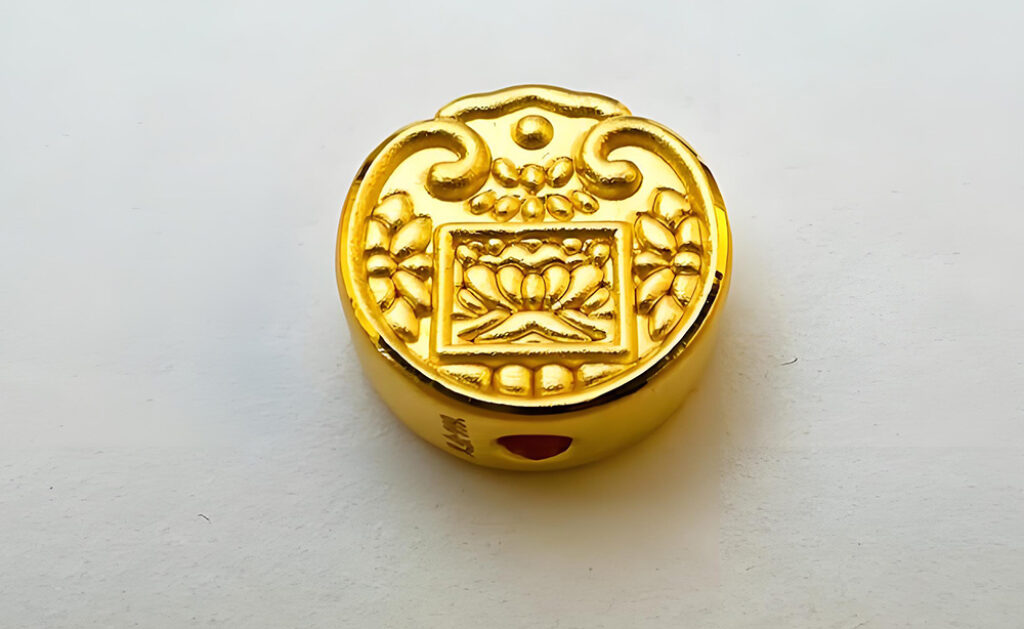
Each approach has different costs, limitations, and use cases. Most “3D printed gold” products you see on the market are produced indirectly rather than printed as solid gold from the start.
3. Is It Possible to 3D Print Real Gold?
Yes, it is possible to 3D print real gold—but only under very specific conditions.
Pure gold can be processed using industrial metal 3D printing technologies such as selective laser melting (SLM) or direct metal laser sintering (DMLS). These machines use powdered gold or gold alloys and fuse them layer by layer using high-powered lasers.
However, this method is:
- Extremely expensive
- Limited to specialized facilities
- Inaccessible to consumers or hobbyists
As a result, direct gold 3D printing is mainly used in high-end jewelry, research environments, and niche industrial applications.
4. How Gold Is 3D Printed in Industry
Industrial gold 3D printing relies on advanced metal additive manufacturing systems. These machines operate in controlled environments and require precise temperature control, laser calibration, and material handling.
Key characteristics of industrial gold 3D printing:
- Uses gold powder or alloy powder
- Requires inert gas chambers
- Operates at extreme energy levels
- Produces near-net-shape metal parts
This approach allows for geometries that are difficult or impossible to achieve through traditional goldsmithing.
5. Direct Gold 3D Printing Technologies
Selective Laser Melting (SLM)
SLM uses a laser to fully melt gold powder into solid metal. The result is dense, high-quality gold parts with strong mechanical properties.
Direct Metal Laser Sintering (DMLS)
DMLS fuses metal powder at high temperatures without fully melting it. For gold alloys, this method offers precision but may require post-processing.
Binder Jetting
Binder jetting uses a binding agent to form a gold powder structure, which is later sintered. This process is less common for gold but shows potential for future scalability.
These technologies confirm that gold metal 3D printing is real, but not practical for everyday users.
6. Indirect Gold 3D Printing: The Most Common Method
Indirect gold 3D printing is by far the most widely used method today, especially in jewelry production.
Instead of printing gold directly, manufacturers:
- 3D print a wax or resin model
- Create a mold from the printed model
- Cast molten gold into the mold
- Finish and polish the final piece
This approach combines digital precision with traditional metallurgy, offering the best balance of cost, quality, and flexibility.
7. Lost Wax Casting and 3D Printing
Lost wax casting has been used for centuries, but 3D printing has transformed the process.
With 3D printing:
- Designs are created digitally
- Wax patterns are printed with extreme accuracy
- Manual carving is eliminated
- Complex internal geometries become possible
This method dominates the 3D printed gold jewelry market and is widely accepted as the industry standard.
8. Gold Filament and Metal-Filled Materials Explained
Some products marketed as “gold filament” can be misleading.
In reality:
- Gold-colored filament is usually PLA or ABS with pigments
- Metal-filled filament may contain brass or bronze, not gold
- True gold content in filament is extremely rare and impractical
Even when gold is present, it does not behave like solid gold after printing. These materials are best viewed as aesthetic alternatives rather than real gold solutions.
9. Can You 3D Print Gold at Home?
For most people, the honest answer is no.
You cannot 3D print solid gold at home using:
- FDM printers
- Resin printers
- Desktop metal printers
What you can do at home is:
- Print wax models for gold casting
- Print resin jewelry masters
- Design gold parts digitally for outsourcing
Home 3D printing plays a crucial role in gold production, just not in direct metal printing.
10. Why Standard 3D Printers Cannot Print Gold
Gold melts at over 1,000°C, far beyond the capabilities of consumer printers. Additionally:
- Gold is highly conductive
- Requires controlled atmospheres
- Demands precise energy distribution
These physical constraints make gold incompatible with standard extrusion or resin-based systems.
11. Gold 3D Printing for Jewelry
Jewelry is where gold 3D printing truly shines.
Designers can:
- Create intricate lattice structures
- Customize rings to exact finger measurements
- Rapidly prototype new designs
- Reduce material waste
Custom gold jewelry 3D printing has reshaped how modern jewelers operate, blending craftsmanship with digital design.
12. Design Considerations for 3D Printed Gold
Designing for gold casting requires specific considerations:
- Wall thickness must be consistent
- Sharp internal corners should be avoided
- Proper sprue placement is critical
- Shrinkage must be accounted for
Professional CAD skills are essential for successful gold printing outcomes.
13. Cost of 3D Printing Gold
Gold 3D printing costs depend on:
- Gold market price
- Printing method
- Design complexity
- Finishing requirements
Direct gold printing can cost thousands of dollars per part, while indirect casting methods are far more affordable and scalable.
14. Gold vs Other Precious Metals in 3D Printing
Compared to gold:
- Silver is easier and cheaper to print
- Platinum requires higher temperatures
- Brass and bronze are popular alternatives
Gold remains the most prestigious but not always the most practical option.
15. Accuracy, Strength, and Finish of 3D Printed Gold
Properly cast gold from 3D printed models:
- Matches traditional gold strength
- Offers excellent surface finish
- Maintains high dimensional accuracy
Post-processing, such as polishing and setting, remains essential.
16. Advantages of Gold 3D Printing
Key benefits include:
- Design freedom
- Customization
- Reduced waste
- Faster iteration cycles
These advantages make gold 3D printing especially attractive for bespoke jewelry.
17. Limitations and Challenges
Despite its promise, gold 3D printing faces challenges:
- High equipment costs
- Technical expertise requirements
- Limited home accessibility
- Complex post-processing
Understanding these limits helps set realistic expectations.
18. Gold 3D Printing Services
Most users rely on professional gold 3D printing services, which handle:
- CAD optimization
- Printing or casting
- Finishing and quality control
This model allows designers to focus on creativity rather than equipment.
19. Is 3D Printed Gold “Real” Gold?
Yes—when produced correctly, 3D printed gold is chemically and physically real gold. It can be hallmarked, sold, and worn just like traditionally made pieces.
The method of shaping gold does not change its authenticity.
20. The Future of Gold 3D Printing
As metal printing technology advances:
- Costs will decrease
- Precision will improve
- Accessibility will expand
Gold 3D printing is expected to become more common, especially in high-end customization.
21. Who Should Consider Gold 3D Printing?
Gold 3D printing is ideal for:
- Jewelry designers
- Luxury brands
- Custom manufacturers
- Digital artisans
It is less suitable for casual hobbyists seeking low-cost solutions.
22. Frequently Asked Questions (FAQs)
Can a normal 3D printer print gold?
No. Standard printers cannot handle gold’s physical requirements.
Is gold filament real gold?
Most gold filaments are not real gold and serve decorative purposes only.
Is 3D printed gold durable?
Yes, when properly cast or printed, it matches traditional gold durability.
How is gold jewelry 3D printed?
Typically through wax or resin printing followed by lost wax casting.
Is gold 3D printing expensive?
Direct printing is very expensive; indirect methods are more affordable.
23. Final Thoughts
So, can you 3D print gold? The answer depends on how you define “print.”
While consumer printers cannot extrude molten gold, modern manufacturing has proven that gold and 3D printing are not only compatible but transformative when combined intelligently. Through indirect methods like lost wax casting and industrial metal printing, gold 3D printing has already reshaped jewelry design and high-end manufacturing.
Understanding the reality behind the technology allows creators to use it effectively—without falling for myths or unrealistic expectations.