How to Make Money With a 3D Printer in 2026: The Ultimate Practical and Business Guide

By 2026, 3D printing has firmly established itself as more than a hobby or experimental technology. It is now an accessible manufacturing method that enables individuals and small businesses to compete in markets once dominated by large factories. Advances in printer reliability, materials, and design software have lowered barriers to entry while expanding commercial opportunities.
Making money with a 3D printer in 2026 is no longer about novelty. Consumers are not impressed simply because something is “3D printed.” What they value is functionality, customization, speed, and problem-solving. This shift has transformed 3D printing into a powerful income tool for those who approach it strategically.
This guide is written for creators, entrepreneurs, and professionals who want to understand not just what to sell, but why certain 3D printing businesses succeed while others fail.
Table of Contents
- The Evolution of 3D Printing as an Income Tool
- Understanding Demand: Who Buys 3D Printed Products and Services
- Core Business Models for Making Money With a 3D Printer
- Selling Physical 3D Printed Products
- Custom and On-Demand 3D Printing Services
- Digital Products: Selling STL Files and Design Assets
- Profitable 3D Printing Niches in 2026
- Materials, Quality, and Product Positioning
- Pricing Strategies That Actually Work
- Startup Costs and Financial Planning
- Marketing a 3D Printing Business
- Scaling From a Single Printer to a Business
- Managing Operations and Workflow
- Legal, Copyright, and Risk Considerations
- Common Mistakes That Kill Profitability
- Long-Term Trends and the Future of 3D Printing Income
- Final Thoughts: Building a Sustainable 3D Printing Business
- Frequently Asked Questions (FAQs)
1. The Evolution of 3D Printing as an Income Tool
In its early years, 3D printing income was driven by novelty items and experimental designs. As the market matured, those opportunities declined, but new ones emerged.
Key Changes by 2026
- Better hardware at lower cost has increased competition.
- Customers are more educated and demand higher quality.
- Design, branding, and service now matter more than machine specs.
- Local manufacturing has regained importance due to supply chain disruptions.
As a result, profitable 3D printing businesses today resemble small manufacturing and design companies, not hobby workshops.
2. Understanding Demand: Who Buys 3D Printed Products and Services
A profitable 3D printing business starts with understanding buyers. In 2026, demand generally comes from four major groups:
Individual Consumers
They seek:
- Personalized products
- Replacement parts
- Home organization solutions
- Accessories for devices or hobbies
Small Businesses
They need:
- Prototypes
- Custom tools
- Short production runs
- Branding elements
Professionals and Creators
Designers, engineers, and content creators often outsource printing to focus on their core work.
Institutions
Schools, training centers, and labs require educational models and custom equipment.
Understanding which group you serve determines your pricing, marketing, and workflow.
3. Core Business Models for Making Money With a 3D Printer
There is no single “best” way to make money with a 3D printer. Successful operators often combine multiple models.
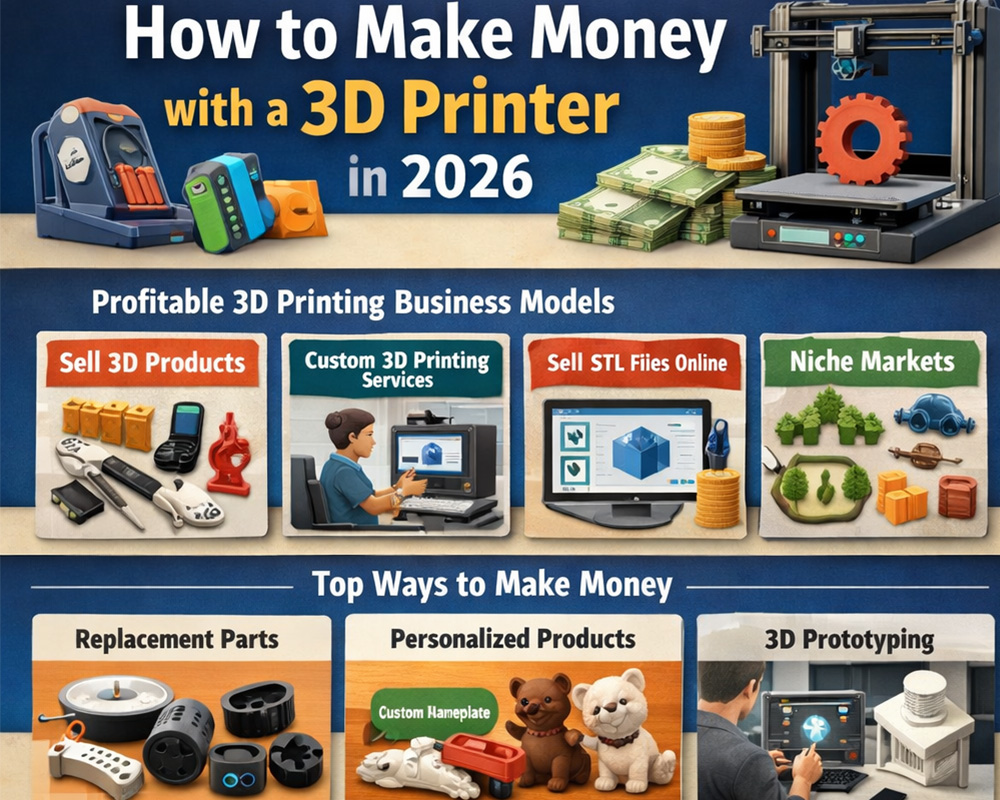
The Four Main Models
- Product Sales – Manufacturing and selling physical items
- Service-Based Printing – Printing on demand for others
- Digital Products – Selling designs and STL files
- Hybrid Models – Combining physical and digital offerings
Each model has different cost structures, risks, and scaling potential.
4. Selling Physical 3D Printed Products
Functional Products vs Decorative Items
Functional products consistently outperform decorative prints in long-term profitability. Customers will pay more for items that solve real problems.
Examples include:
- Cable management systems
- Custom mounts and brackets
- Storage and organization tools
- Automotive accessories
- Workshop aids
Customization as a Competitive Advantage
Customization allows small businesses to compete against mass-produced products. Even small adjustments—size, shape, compatibility—add value.
Customers often pay a premium for products that fit their exact needs.
Replacement Parts: A High-Margin Opportunity
Replacement parts are one of the most reliable income streams in 3D printing.
Why they work:
- Low material cost
- High urgency
- Limited alternatives
- Strong perceived value
This category alone can sustain a profitable microbusiness.
5. Custom and On-Demand 3D Printing Services
Local 3D Printing Services
Many customers prefer local providers for faster turnaround and direct communication. Local services often include:
- Rapid prototyping
- Custom enclosures
- Architectural models
- Educational tools
Business-to-Business (B2B) Services
B2B clients tend to order repeatedly and are less price-sensitive. They value reliability, consistency, and professional communication.
White-Label Production
Some designers sell products but outsource printing and fulfillment. Acting as a production partner can create predictable income.
6. Digital Products: Selling STL Files and Design Assets
Why Digital Products Matter
Digital products decouple income from machine runtime. Once created, a design can be sold repeatedly with minimal additional cost.
What Makes a Good STL Product
- Solves a specific problem
- Easy to print
- Compatible with common printers
- Minimal post-processing
Licensing and Commercial Rights
Some creators sell licenses allowing buyers to sell physical prints. This expands income without increasing production.
Digital products are often the most scalable part of a 3D printing business.
7. Profitable 3D Printing Niches in 2026
Personalization and Mass Customization
Consumers expect products tailored to them. Parametric designs enable fast customization without redesigning from scratch.
Sustainable and Repair-Oriented Products
Eco-friendly products that extend the life of existing items resonate strongly in 2026.
Professional Accessories
Industries like photography, electronics, gaming, and DIY rely heavily on custom accessories.
Education and Training
Physical models improve learning outcomes, creating ongoing demand.
8. Materials, Quality, and Product Positioning
Material Selection
Choosing the right material affects cost, durability, and customer satisfaction. Profitability depends on balancing performance with efficiency.
Quality Control
Consistent quality builds trust and repeat customers. Failed prints, poor finishes, and inaccurate dimensions damage reputation.
Positioning
Your brand should clearly communicate whether you focus on:
- Affordability
- Customization
- Professional quality
- Speed
Trying to compete on all fronts rarely works.
9. Pricing Strategies That Actually Work
Cost-Based vs Value-Based Pricing
Pricing only by material cost undervalues your work. Customers pay for outcomes, not filament weight.
Factors That Should Influence Pricing
- Design time
- Print time
- Customization complexity
- Market demand
- Expertise
Tiered Pricing
Offering multiple options helps customers self-select while protecting margins.
10. Startup Costs and Financial Planning
Initial Investment
Startup costs vary widely, but most businesses can begin with:
- One or two reliable printers
- Core materials
- Basic tools
- Software
- Branding assets
Managing Cash Flow
Tracking costs and time is critical. Many failed ventures underestimate labor and maintenance expenses.
11. Marketing a 3D Printing Business
Content and Education
Explaining how your products solve problems builds trust and authority.
Visual Presentation
Clear photos, demonstrations, and explanations increase conversion rates.
Platform Strategy
Selling directly, locally, or through marketplaces each requires a different approach.
12. Scaling From a Single Printer to a Business
Adding Capacity
Scaling usually involves adding machines rather than upgrading a single one.
Standardization
Consistent materials and settings reduce errors and speed up production.
Automation
Automating order intake, design adjustments, and communication improves efficiency.
13. Managing Operations and Workflow
Efficient operations are often the difference between a hobby and a business.
Key elements include:
- Print scheduling
- Maintenance routines
- Order tracking
- Customer communication
14. Legal, Copyright, and Risk Considerations
Intellectual Property
Only sell designs you own or have permission to use.
Custom Work Agreements
Define ownership clearly when creating custom designs for clients.
Product Liability
Functional products should include disclaimers and testing procedures.
15. Common Mistakes That Kill Profitability
- Competing only on price
- Selling undifferentiated products
- Ignoring customer experience
- Scaling too fast
- Underestimating time costs
Avoiding these mistakes significantly improves success rates.
16. Long-Term Trends and the Future of 3D Printing Income
By 2026, profitable operators increasingly leverage:
- AI-assisted design tools
- Parametric modeling
- Subscription-based offerings
- Hybrid digital-physical products
Adaptability is a major competitive advantage.
17. Final Thoughts: Building a Sustainable 3D Printing Business
Making money with a 3D printer in 2026 is realistic and scalable, but it requires a business mindset. The most successful operators focus on solving problems, building systems, and delivering consistent value.
3D printing is not the product—the solution you provide is.
18. Frequently Asked Questions (FAQs)
Is 3D printing still profitable in 2026?
Yes. Profitability depends on niche selection, execution, and pricing rather than technology alone.
What is the most reliable way to make money with a 3D printer?
Functional products, replacement parts, and B2B services offer consistent demand.
Can beginners succeed in 3D printing businesses?
Yes, by starting simple, controlling costs, and validating demand early.
Are digital products better than physical products?
Digital products offer higher scalability, while physical products provide steady cash flow. Many businesses use both.
Do I need expensive printers to make money?
No. Reliability and workflow matter more than high-end features.