
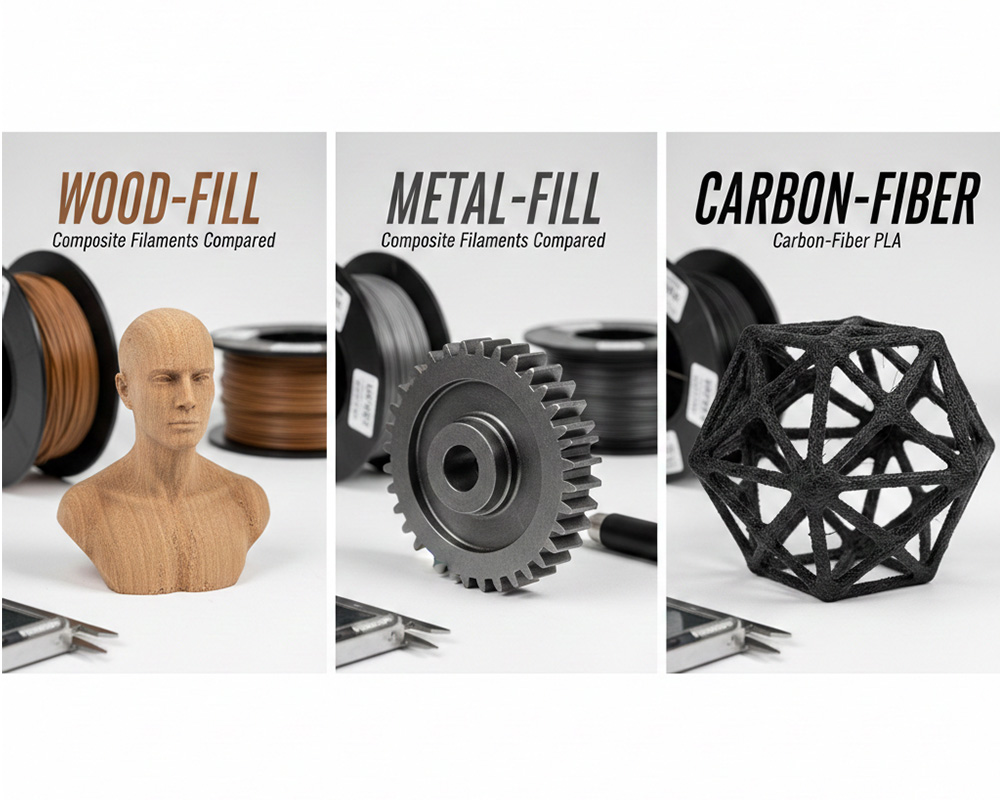
3D printing has evolved far beyond standard PLA and ABS. Today, creators, engineers, makers, and industrial designers often rely on composite filaments—materials that mix PLA with additives such as wood fibers, metal powders, or carbon fiber to radically change performance, functionality, appearance, and tactile qualities.
Composite filaments allow for things that traditional plastics simply cannot offer: realistic wood textures, cold-to-the-touch metal surfaces, or lightweight yet highly rigid structures. For many users, they unlock a new level of creativity and engineering possibility.
But which composite filament is right for your project? And what should you expect in terms of printability, durability, mechanical performance, appearance, and practical use cases?
This comprehensive comparison dives deep into:
- Wood-Fill PLA
- Metal-Fill PLA
- Carbon-Fiber PLA
We’ll explore their properties, strengths, limitations, printing requirements, best applications, surface finishing potential, and overall cost-performance ratio to help you make an informed choice.
1. Understanding Composite PLA Filaments
What Is a Composite Filament?
A composite filament is a base polymer (usually PLA) infused with another material—such as ground wood, fine metal powder, or chopped carbon fiber.
These additives significantly modify:
- Mechanical properties (strength, stiffness, brittleness)
- Surface appearance (texture, sheen, pattern)
- Weight (heavier or lighter depending on filler)
- Print behavior (nozzle wear, extrusion smoothness, risk of clogs)
- Thermal performance (heat resistance, thermal conductivity)
- Post-processing options (sanding, polishing, staining, machining)
PLA is the most common base because it:
- Prints easily
- Has a low melting point
- Mixes well with fillers
- Is biodegradable and plant-based
The filler percentage varies widely between brands—from 5% all the way to 40% or more, influencing aesthetics and mechanical consistency.
2. Wood-Fill PLA: Warm Aesthetics and Natural Texture
Overview
Wood-fill PLA combines standard PLA with fine wood fibers. Depending on the brand, additives may include bamboo, pine, cedar, or generic recycled wood powder.
The result is a filament that looks and feels like genuine wood—ideal for artistic, decorative, or organic-looking models.
2.1 Mechanical Properties
| Property | Wood-Fill PLA Characteristics |
| Strength | Slightly weaker than PLA |
| Stiffness | Similar to standard PLA |
| Layer Adhesion | Good, but can become brittle with age |
| Heat Resistance | Comparable to PLA |
| Weight | Light; similar to or slightly lighter than PLA |
Wood particles reduce the polymer-to-polymer bonds, making prints:
- Less strong than pure PLA
- More brittle under sudden impact
- Sensitive to moisture if left unsealed
However, for decorative pieces, this rarely presents an issue.
2.2 Printability
Wood-fill is generally easy to print, but requires attention to:
- Nozzle size → 0.5 mm or larger recommended
- Temperature → often slightly lower than PLA to avoid burning wood fibers
- Stringing → additive increases risk
- Clogging → possible if printing too slowly or too cool
Notably, wood-fill smells like toasted wood while printing—pleasant for most.
2.3 Aesthetic Qualities
Wood-fill PLA is one of the most visually appealing composites:
- Natural, matte finish
- Visible wood grain
- Warm organic color tones
- Can be sanded, stained, or varnished like real wood
The ability to stain the surface is a major advantage—few 3D printing materials allow such traditional finishing.
2.4 Best Uses for Wood-Fill PLA
- Home décor objects
- Sculptures & art pieces
- Architectural models
- Cosplay props with wooden textures
- Figurines
- Product prototypes needing a warm, natural appearance
Wood-fill PLA is not recommended for mechanical components or parts with load-bearing requirements.
3. Metal-Fill PLA: Weight, Shine, and Realistic Metallic Properties
Overview
Metal-fill filaments combine PLA with fine metal powders, such as:
- Bronze
- Copper
- Brass
- Stainless steel
- Aluminum
They produce prints that look and feel like real metal, often including:
- Metallic sheen
- Cool temperature to the touch
- Substantial weight (depending on loading)
These filaments can be polished to mirror-like shine.
3.1 Mechanical Properties
| Property | Metal-Fill PLA Characteristics |
| Strength | Lower than PLA (more brittle) |
| Stiffness | Higher density; feels rigid |
| Weight | Significantly heavier |
| Durability | Lower impact resistance |
| Heat Resistance | Slight increase due to metal powder |
The metal particles interfere with the polymer matrix, resulting in:
- Reduced impact strength
- Greater brittleness
- Higher density and premium feel
Because of its weight and metallic finish, metal-fill is popular for aesthetic parts, props, and jewelry.
3.2 Printability
Metal-fill is more challenging to print than wood or carbon fiber:
- Abrasive to brass nozzles (use hardened steel)
- Requires consistent extrusion flow
- Increased risk of clogging due to particulate density
- Higher printing temperature recommended
The filament’s density also increases retraction requirements, making tuning essential.
3.3 Aesthetic Qualities
Post-processing is where metal-fill shines:
- Sanding exposes metal particles
- Polishing produces a real metallic shine
- Patina finishing (e.g., for copper or bronze) gives an antique effect
- Weight adds realism unmatched by paints or faux textures
Different powders produce unique appearances—bronze and copper are especially popular for artistic work.
3.4 Best Uses for Metal-Fill PLA
- Jewelry (pendants, rings, earrings)
- Cosplay props requiring heavy, metallic feel
- Sculptures
- Premium product prototypes
- Display models
- Decorative home accessories
- Commemorative items
Metal-fill is not suitable for structural parts or mechanical load-bearing designs.
4. Carbon-Fiber PLA: Lightweight Strength and Engineering Performance
Overview
Carbon-fiber PLA blends PLA with chopped carbon fiber strands. This produces a filament known for:
- High stiffness
- Low weight
- Matte professional finish
- Excellent dimensional accuracy
- Reduced warping
It is widely used in engineering, robotics, drones, automotive prototyping, and functional part design.
4.1 Mechanical Properties
| Property | Carbon-Fiber PLA Characteristics |
| Strength | Higher tensile strength than PLA |
| Stiffness | Significantly improved |
| Weight | Much lighter |
| Durability | Strong but more brittle |
| Heat Resistance | Slightly enhanced |
Carbon-fiber PLA excels in stiffness, making it ideal for parts that need to stay rigid under stress. However, it can snap rather than bend, and therefore is not ideal where flexibility is needed.
4.2 Printability
This filament prints exceptionally well, but with specific requirements:
- Highly abrasive → must use a hardened steel or ruby nozzle
- Excellent layer adhesion
- Very low warping (easier than ABS/carbon composites)
- Smooth extrusion and high repeatability
Many users find carbon-fiber PLA easier to print than standard PLA due to its rigidity, which reduces stringing and oozing.
4.3 Aesthetic Qualities
Carbon-fiber PLA provides:
- A sleek, matte black finish
- Professional, engineering-grade appearance
- Fine, consistent texture
- Minimal visible layer lines
Unlike metal-fill or wood-fill, it does not require post-processing to look premium.
4.4 Best Uses for Carbon-Fiber PLA
- Drone frames
- RC car components
- Camera mounts and stabilizers
- Jigs and fixtures
- Mechanical brackets
- Robotics components
- Structural prototypes
- Automotive hobby parts
Because of its stiffness-to-weight ratio, carbon-fiber PLA is the most functional of the three composites.
5. Direct Comparison: Wood-Fill vs. Metal-Fill vs. Carbon-Fiber PLA
5.1 Printability Comparison
| Feature | Wood-Fill | Metal-Fill | Carbon-Fiber PLA |
| Ease of Printing | Easy | Moderate-Difficult | Easy-Moderate |
| Nozzle Wear | Low-Moderate | High | Very High |
| Clogging Risk | Medium | High | Low-Medium |
| Temperature Sensitivity | Medium | High | Medium |
| Warping | Low | Low | Very Low |
Carbon-fiber PLA is the most stable composite to print, while metal-fill is the most demanding.
5.2 Mechanical Performance Comparison
| Performance | Wood-Fill | Metal-Fill | Carbon-Fiber PLA |
| Strength | Low | Low | High |
| Rigidity | Medium | Medium | Very High |
| Density | Light | Heavy | Very Light |
| Impact Resistance | Low | Low | Medium |
| Heat Resistance | Low | Medium | Medium |
Carbon-fiber PLA is the only composite suited for functional prototypes.
5.3 Aesthetic and Surface Finish Comparison
| Feature | Wood-Fill | Metal-Fill | Carbon-Fiber PLA |
| Appearance | Natural, organic | Metallic, glossy | Matte, technical |
| Sandability | Excellent | Excellent | Moderate |
| Polishability | Not applicable | Excellent | Low |
| Realistic Texture | Wood-like | Metal-like | Carbon matte |
| Post-Processing Options | Stain, sand, varnish | Polish, patina | Limited |
Metal-fill offers the broadest finishing potential.
5.4 Cost Comparison
Wood-fill tends to be the cheapest composite, while carbon-fiber PLA can range widely depending on brand and fiber content. Metal-fill is the most expensive due to material density and manufacturing complexity.
5.5 Best Use Cases Summary
| Application Type | Best Filament |
| Art, décor, organic shapes | Wood-Fill PLA |
| Jewelry, props, premium models | Metal-Fill PLA |
| Structural components, engineering prototypes | Carbon-Fiber PLA |
6. Choosing the Right Composite Filament: A Practical Guide
If You Want the Easiest Printing Experience
→ Choose Wood-Fill PLA
If You Want the Best Professional Appearance Without Much Post-Processing
→ Choose Carbon-Fiber PLA
If You Want Heavy, Realistic, Metallic Objects
→ Choose Metal-Fill PLA
If You Want Strong, Lightweight Functional Parts
→ Choose Carbon-Fiber PLA
If You Want Creative and Artistic Finishes
→ Choose Wood-Fill PLA (or Metal-Fill if you enjoy polishing)
7. Nozzle and Printer Requirements
For Wood-Fill PLA
- 0.5 mm+ nozzle recommended
- Brass nozzle acceptable
- Print at moderate temperatures (190–210°C)
For Metal-Fill PLA
- Hardened steel nozzle essential
- Consider slower print speeds
- Print at 200–230°C depending on material
For Carbon-Fiber PLA
- Hardened steel or ruby nozzle mandatory
- Bowden systems may need increased retraction
- Print around 210–230°C
8. Post-Processing Techniques
Wood-Fill PLA
- Sand lightly for smooth grain
- Apply wood stain for rich color
- Coat with clear varnish
- Carve or engrave details post-print
Metal-Fill PLA
- Wet sanding reveals metallic shine
- Polish with metal compounds
- Apply patina (vinegar/salt for copper, etc.)
- Can be buffed to mirror finish
Carbon-Fiber PLA
- Light sanding possible but not needed
- Best kept in natural matte finish
- Painting works, but adhesion varies
9. Longevity and Environmental Considerations
Wood-Fill PLA
- Biodegradable PLA + natural fibers
- Moisture sensitive
- Best stored dry
Metal-Fill PLA
- Metal powders are stable but heavy
- PLA base still biodegradable over long periods
- Requires dry storage
Carbon-Fiber PLA
- Fibers do not degrade
- Strong material but becomes brittle under extreme load
- Also requires dry storage
10. Real-World Case Studies
Case Study 1: Architectural Studio Using Wood-Fill PLA
A design firm printed miniature building models with wood-fill PLA to mimic natural materials like oak and pine. The models were later stained and varnished, giving clients a realistic sense of material finish.
Case Study 2: Maker Producing Brass Props With Metal-Fill PLA
A prop designer created medieval armor pieces using brass-fill PLA. After polishing and weathering, the props appeared indistinguishable from metal while being far easier to carry during long events.
Case Study 3: Engineering Team Prototyping With Carbon-Fiber PLA
A robotics group printed lightweight drone arms using carbon-fiber PLA. The stiffness and dimensional accuracy allowed for rapid iteration without needing expensive carbon layups or CNC parts.
11. Final Recommendations
Best Overall for Functional Prints: Carbon-Fiber PLA
Its strength-to-weight ratio and dimensional accuracy make it the most versatile composite for engineering or mechanical parts.
Best for Aesthetics: Metal-Fill PLA
Its weight, polishability, and metallic look give unmatched realism for artistic or display models.
Best for Creative and Organic Designs: Wood-Fill PLA
Its texture, smell, and ability to take stains make it ideal for décor, models, and sculptural work.
Choosing the right composite depends on your project’s priorities—appearance, strength, printability, or post-processing flexibility.
FAQs
1. Which composite filament is the strongest?
Carbon-fiber PLA is the strongest and stiffest of the three, making it ideal for load-bearing or structural parts.
2. Will composite filaments damage my nozzle?
Wood-fill causes minor wear, but metal-fill and carbon-fiber PLA are highly abrasive. A hardened steel or ruby nozzle is strongly recommended.
3. Can I use a standard PLA profile for composites?
You can start with it, but you should adjust:
- Nozzle temperature
- Retraction
- Speed
Each composite has unique flow characteristics.
4. Which filament is best for beginners?
Wood-fill is the easiest composite to print with, assuming a slightly larger nozzle is used.
5. Are composite filaments safe?
Generally yes. However, printing metal-fill or wood-fill can release fine particulates. Good ventilation is recommended.
6. Do composite filaments require special storage?
Yes. All PLA-based composites should be stored in dry conditions because PLA absorbs moisture.
7. Can I sand composite filaments?
- Wood-fill sands beautifully
- Metal-fill sands exceptionally well
- Carbon-fiber PLA sands, but minimally changes appearance
8. Are composite filaments eco-friendly?
PLA is biodegradable, but additives (metal powder, carbon fiber) are not. Wood-fill has the lowest environmental footprint.
Conclusion
Composite PLA filaments are powerful tools for makers, designers, engineers, and hobbyists. Whether you want the natural beauty of wood-fill, the premium weight and shine of metal-fill, or the lightweight structural performance of carbon-fiber PLA, each filament opens the door to creative possibilities traditional filaments can’t offer.
Understanding their mechanical properties, printability, and best-use cases allows you to select the ideal material for your project—enhancing both performance and aesthetics.